
 光明网
I.Steady growth of fixed assets investment promoting high-quality development
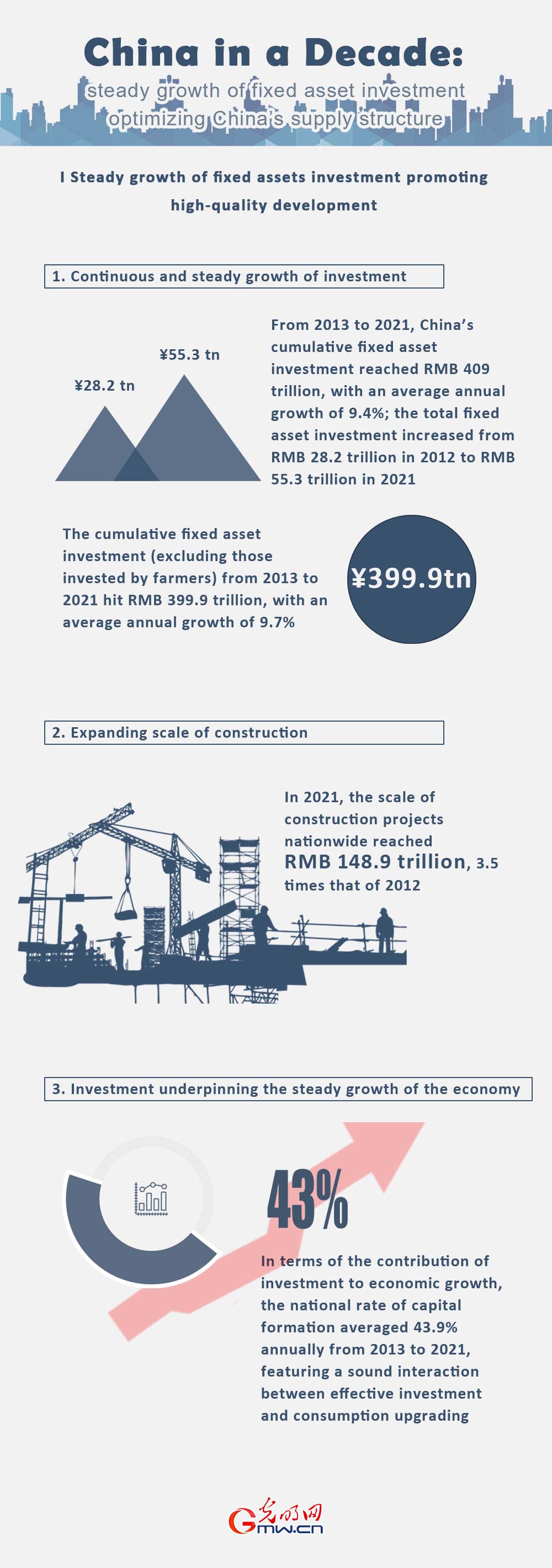
1.Continuous and steady growth of investment From 2013 to 2021,
China’s cumulative fixed asset investment reached RMB 409 trillion, with
an average annual growth of 9.4%; the total fixed asset investment
increased from RMB 28.2 trillion in 2012 to RMB 55.3 trillion in 2021.
The cumulative fixed asset investment (excluding those invested by
farmers) from 2013 to 2021 hit RMB 399.9 trillion, with an average
annual growth of 9.7%.
2.Expanding scale of construction In 2021, the scale of construction
projects nationwide reached RMB 148.9 trillion, 3.5 times that of 2012;
the scale of new construction projects reached RMB 37.0 trillion, 2.3
times that of 2012.
3.Investment underpinning the steady growth of the economy In terms
of the contribution of investment to economic growth, the national rate
of capital formation averaged 43.9% annually from 2013 to 2021,
featuring a sound interaction between effective investment and
consumption upgrading. The Gross Fixed Capital Formation (GFCF) in 2021
contributed 1.1 percentage points to GDP growth, and fixed asset
investment played an effective support role to the stable growth of the
economy.
II.Optimized industrial investment with a sound structure
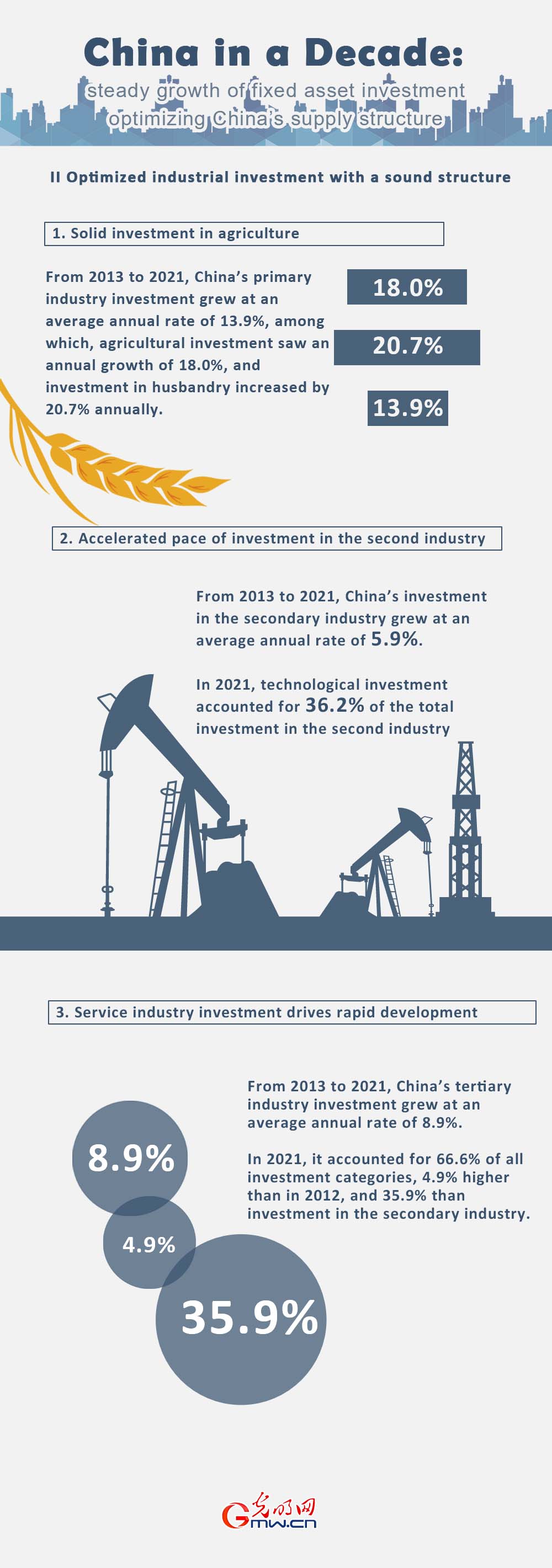
1.Solid investment in
agriculture From 2013 to 2021, China’s primary industry investment grew
at an average annual rate of 13.9%, with a growth rate 4.2 percentage
points higher than that of all investment categories. Among which,
agricultural investment saw an annual growth of 18.0%, and investment in
husbandry increased by 20.7% annually. Since 2012, investment in the
primary industry has steadily increased.
2.Accelerated pace of
investment in the second industry From 2013 to 2021, China’s investment
in the secondary industry grew at an average annual rate of 5.9%. In
2021, technological investment accounted for 36.2% of the total
investment in the second industry, 3.8 percentage points higher than in
2012, making technological investment the main driving force of
industrial investment.
3.Service industry investment
drives rapid development From 2013 to 2021, China’s tertiary industry
investment grew at an average annual rate of 8.9%. In 2021, it accounted
for 66.6% of all investment categories, 4.9 percentage points higher
than in 2012, and 35.9 percentage points higher than investment in the
secondary industry.
III.Synergized regional investment empowering coordinated development
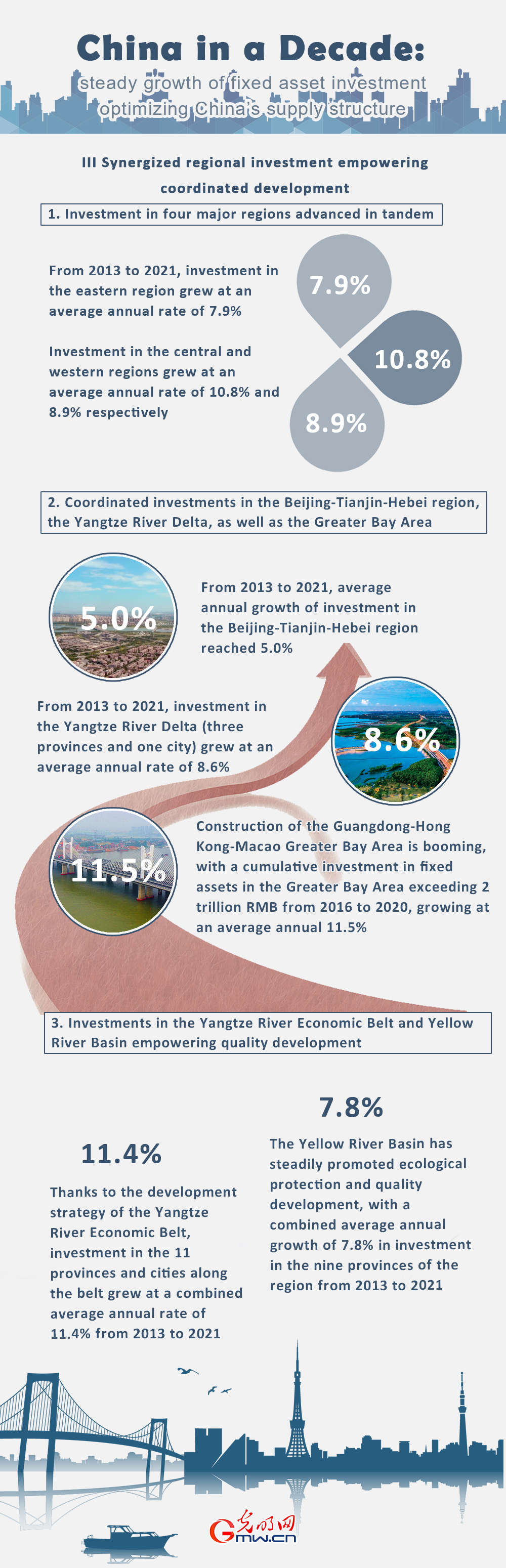
1.Investment in four major
regions advanced in tandem From 2013 to 2021, investment in the eastern
region grew at an average annual rate of 7.9%, with the eastern region
accounting for 44.4% of national investment in 2021, down 0.7 percentage
points from 2012; investment in the central and western regions grew at
an average annual rate of 10.8% and 8.9% respectively, with the central
and western regions accounting for 26.2% and 26.3% of national
investment in 2021, up 5.4 and 1.8 percentage points respectively from
2012.
2.Coordinated investment in
the Beijing-Tianjin-Hebei region, the Yangtze River Delta, as well as
the Greater Bay Area From 2013 to 2021, the average annual growth rate
of investment in the Beijing-Tianjin-Hebei region reached 5.0%. Hebei’s
information transmission, software and IT industry increased by 22.8%.
From 2013 to 2021, investment in the Yangtze River Delta (three
provinces and one city) grew at an average annual rate of 8.6%,
development in the region has become more integrated, its infrastructure
has become more interconnected, and a modern, integrated transport
system has emerged in the region. The construction of the Guangdong-Hong
Kong-Macao Greater Bay Area is booming, with a cumulative investment in
fixed assets in the Greater Bay Area exceeding RMB 2 trillion from
2016-2020, growing at an average annual growth of 11.5%, and major
infrastructure projects such as the Hong Kong-Zhuhai-Macao Bridge and
the Hong Kong section of the Guangzhou-Shenzhen-Hong Kong High-speech
Railway have been completed.
3.Investment in the Yangtze
River Economic Belt and Yellow River Basin empowering high-quality
development Thanks to the development strategy of the Yangtze River
Economic Belt, investment in the 11 provinces and cities along the belt
grew at a combined average annual rate of 11.4% from 2013 to 2021, 1.7
percentage points higher than the national average; the Yangtze River
Economic Belt accounted for 44.3% of China’s total investment in 2021,
8.0 percentage points higher than in 2012. The Yellow River Basin has
steadily promoted ecological protection and high-quality development,
with a combined average annual growth of 7.8% in investment in the nine
provinces of the region from 2013 to 2021. In recent years, the Yellow
River Basin has optimally adjusted its economic and productivity layout,
its investment growth in 2020 and 2021 was 1.1 and 0.7 percentage
points higher than the national average.
IV.Infrastructure investment advances with remarkable result of livelihood-related investment
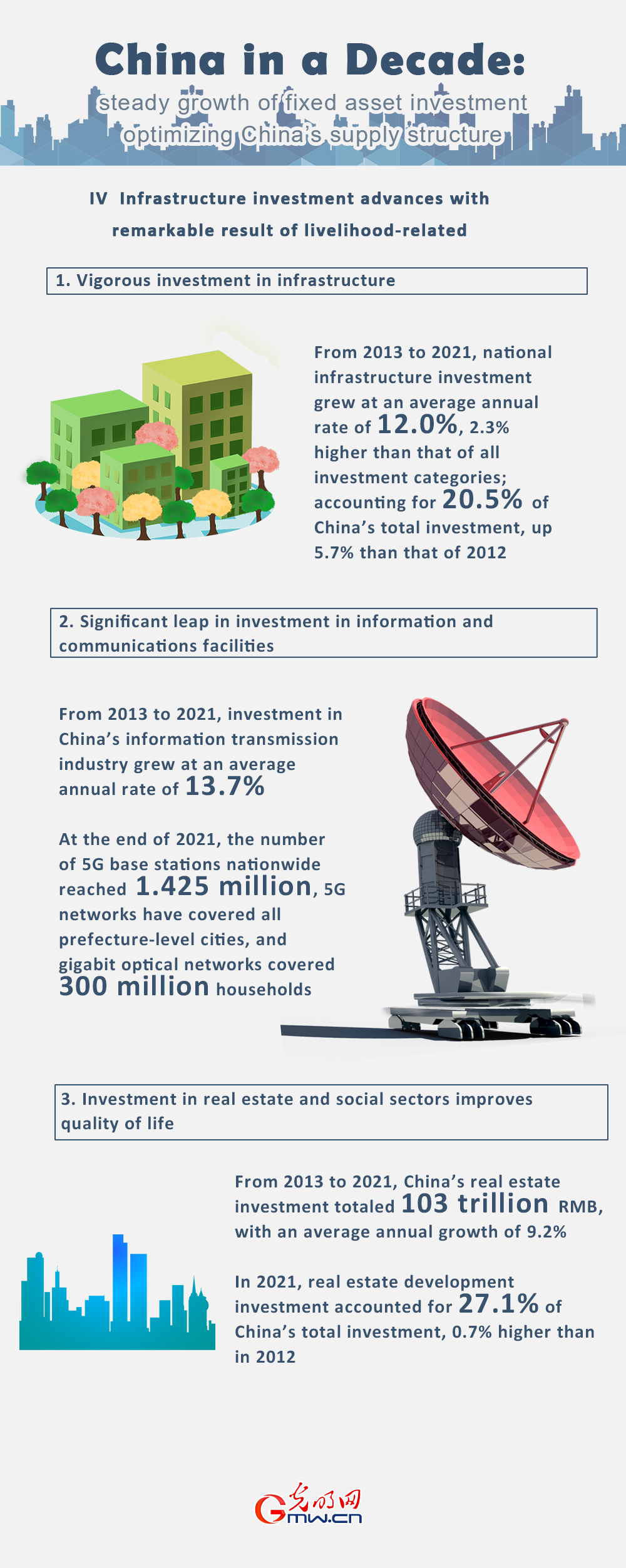
1.Vigorous investment in
construction, transport, and water conservancy projects From 2013 to
2021, national infrastructure investment grew at an average annual rate
of 12.0%, 2.3 percentage points higher than that of all investment
categories; accounting for 20.5% of China’s total investment, up 5.7
percentage points than that of 2012.
2.Significant leap in
investment in information, communications, and public facilities From
2013 to 2021, investment in China’s information transmission industry
grew at an average annual rate of 13.7%. At the end of 2021, the number
of 5G base stations nationwide reached 1.425 million, 5G networks have
covered all prefecture-level cities, and gigabit optical networks
covered 300 million households.
3.Investment in real estate
and social sectors improves quality of life From 2013 to 2021, China’s
real estate investment totaled 103 trillion yuan, with an average annual
growth of 9.2%. In 2021, real estate development investment accounted
for 27.1% of China’s total investment, 0.7 percentage points higher than
in 2012; from 2018 to 2021, investment in the social sector grew at an
average annual rate of 11.9%, 7.1 percentage points higher than that of
all investment categories. Among them, investment in education grew at
an average annual rate of 12.1%, laying a solid foundation for
popularization of compulsory education and universal access to higher
education.
V.Growing endogenous momentum drives investment development
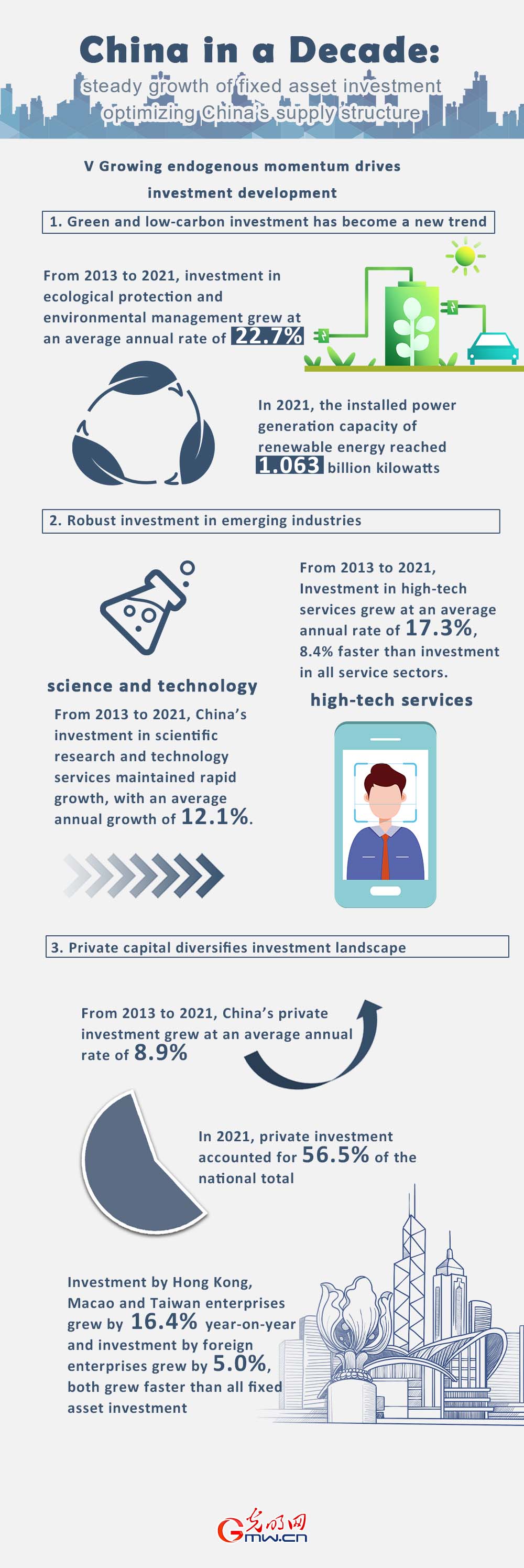
1.Green and low-carbon
investment has become a new trend From 2013 to 2021, China’s investment
in ecological protection and environmental management grew at an average
annual rate of 22.7%, with increasing efforts in ecological protection,
continuous investment in environmental infrastructure, and effective
treatment of pollution sources. In 2021, the installed power generation
capacity of renewable energy reached 1.063 billion kilowatts, accounting
for 44.8% of the total installed capacity, with wind and photovoltaic
power generation reaching 96.9% and 98% respectively, and new progress
was made in the consumption of clean energy.
2.Robust investment in emerging
industries From 2013 to 2021, China has placed science and technology
innovation at the core of the overall national development, and
investment in scientific research and technology services has maintained
rapid growth, with an average annual growth of 12.1%. Investment in
high-tech industries grew at an average annual rate of 16.3%. Investment
in high-tech services grew at an average annual rate of 17.3%, 8.4
percentage points faster than the investment in all service sectors.
3.Private capital diversifies
the investment landscape From 2013 to 2021, China’s private investment
grew at an average annual rate of 8.9%, accounting for more than half of
all investment categories. In 2021, private investment accounted for
56.5% of the national total. Investment by Hong Kong, Macao and Taiwan
enterprises grew by 16.4% year-on-year and investment by foreign
enterprises grew by 5.0%, both grew faster than all categories of fixed
asset investment.
本文著作权归光明网及原作者所有
如有侵权请联系引力播